And Then There Was This ~ Poppa Played The Dobro
I got to thinking about Josh Graves the other day.
There are very few musicians that have impacted their chosen instruments as creators of a musical style. I’m not talking about the hot new guitarist or banjo player of the week. I’m talking about the Teachers. The ones who truly blazed a new trail playing music.
Near the top of the list in guitar type instruments are: Andres Segovia, Sabicas, Chet Atkins, Earl Scruggs and Burkett, “Uncle Josh”, Graves.
Uncle Josh took his bluesy style on the Dobro and added some Scruggs style right hand techniques and came up with a wildly infectious style that touches virtually every Dobro player today
“Dobro” is a brand name, a guitar construction description and, when written in lower case, a generic term for playing a guitar using a hand held metal “slide” or bar. For a musician to call themselves a Dobro player the guitar must have a resonator in it for that resonator under its bridge is what gives the instrument its distinctive tone.
“Dobro” is now a registered trademark of Gibson Inc. although they did not invent or develop the guitar in its basic form. It was invented by a team of brothers named Dopyera “Do-(pyera) Bro-(thers), being a mix of the last name and the word brothers, in the late twenties and has retained its basic form for over eighty years. Their form is very recognizable due to a round, chrome plated cover used to cover the abovementioned resonator.
I got to thinking about Josh Graves the other day.
I think of him often…after all it was he that inspired me (among others) to play the Dobro guitar. I can’t play a Dobro and not think of Buck Graves… “Uncle Josh.”
I didn’t really focus on the instrument for years. Even though my dad played a lot of country on the radio at home I didn’t get The Call to play dobro. I was immersed in learning to play guitar like Chet Atkins and my dad didn’t care for “hillbilly” music that featured banjos and such. I never did learn how to play like Chet Atkins, by the way, but I did get a fair grasp on playing finger style guitar.
Then one day I happened to hear Flatt and Scruggs doing Randy Lynn Rag. Buck Graves (as Uncle Josh was known for a long time) took his solo on the song and it just hit me that this instrument was one I needed in my life. I had no idea what it was. I had no idea what it even looked like. I just knew I had to learn how to play whatever that thing was.
This epiphany happened when I was just eighteen or nineteen. In those days I would spend my summers with a family of folks who lived in Hastings, MI. There were three boys and the sire, all musicians, in this clan. We would put on a stack of country LP records at dinner and soak up the music. After dinner we’d go into the ‘front room’ and play country music using guitars, mandolin and bass.
We all puzzled over this thing Buck Graves played and never really understood it until we made the pilgrimage to the Ryman Auditorium and the Grand Ol’ Opry and actually saw Flat and Scruggs and the Foggy Mountain Boys play Randy Lynn Rag onstage.
That did it! Now I knew what I was aiming at and understood that, because it used a steel bar like a Hawaiian guitarists and country steel players did, I was going to have to make some changes.
Still, it was just an idea for a long time. A nice idea, but since I didn’t have proper instrument not much could be done in learning it.
In my early twenties I met and was befriended by Jerry Garcia. Jerry was into bluegrass at the time (around 1962) and was most helpful in getting me on the road to being a Dobro player. I had borrowed an all metal National guitar from my uncle and set it up to play “lap steel” style. Nationals had resonators too, but it still didn’t sound as good as the wooden bodied instruments Uncle Josh played.
Jerry kept saying “Ya gotta do this like Uncle Josh…you gotta do that like Uncle Josh” and he would play the records and point out the licks. After I got my hands on the National guitar Jerry started drifting toward playing blues with “Pig Pen” McKernan, Bobby Weir and Phil Lesh, heading down the path that eventually became the Grateful Dead so I didn’t get much time in on playing Dobro with him but I had paid close attention to what he told me about how to play it. Eventually we got hold of an old wood bodied “Regal” Dobro for a very good price. It had seen some neglect but it still sounded pretty good. Jerry bought it and kept it but the novelty wore off and he loaned it to me. When it was obvious he was going to be playing electric guitar for a living Jerry gifted the wooden instrument to me and the metal National was retired forever.
When my pet Gretsch electric guitar got stolen I devoted even more time to the Dobro and, lo, it came to pass that I would get to meet and actually play with none other than Burkett Graves, Uncle Josh…
There was this guy I knew who was a bit of a character. Wayne Dye was his name. He was a Good Ol’ Boy-Foghorn Leghorn talking kind of guy, who loved country music and he liked me playing with him. We would get together and pick from time to time. Wayne sang fairly well, kept good rhythm and all that. He wasn’t what they would call star quality but he was not bad, either. But he did like the idea of being a promoter, figuring if he was running the show he could book the star and get to sing with him too which, on the face of it, wasn’t all that bad an idea.
The thing about booking a ‘name’ was that the more popular the name the more they cost. So Wayne did some shopping around and found Uncle Josh to be available complete with a singer named Bobby Smith, for a very reasonable price.
Some fellow promoters had warned him that, while Josh was certainly a fine musician it was hard enough to get a good draw with even a good, well known bluegrass group Uncle Josh Graves just didn’t have a lot of draw power. Few people knew who he was in the grand scheme of things. Fewer people even knew what a Dobro was.
Be that as it may, the price was right and Josh and Bobby were more than happy to be bed and boarded at Wayne’s house for the duration to save money. So Wayne booked Josh and Bobby for four engagements.
Now all he needed was a band!
We got to know some other musicians, Richard Somers, a fine mandolin player, Tony Tichenor, a part Hawaiian guy who had spent many a day with Richard in New Orleans busking came in as a bass player. They had been friends for years. Richard even had a song that was taken up and recorded by David Grisman.
Both Richard and Tony were recent participants in Back In The Saddle a fine western swing group headed by Tom Rigney that, sadly, had disbanded. Tony also some songs using an all metal nickel plated National resonator guitar. Both men were good entertainers and had years of busking and scrambling as professional musicians. Like some friends do they tended to bicker some.
Wayne hired good lead flattop player, another southern guy, Tommy Mayfield and, to round the band out, he hired a “girl singer” named Bonnie. (I’m sorry but I have forgotten her last name) Jack Mace, the banjo player, had his own agenda. He fancied the idea of meeting groupies but that never really worked because we were just the sidemen. The audiences came to see Josh. But he still played very decent banjo.
I and the guitar player, Tommy Mayfield, were older and avoided the politics. We just wanted to play the music and get it as right as we were able. So even with all that simmering beneath the surface we all did our duty and got our list as tight as we could.
Before I go on I should mention that the word “hire” should be applied very loosely in this tale. We backing musicians would only be getting paid if there was any money left over after paying Josh and Bobby and their travel expenses.
The male musicians actually played pretty decently for a bunch of guys who had just formed up. Everyone knew and played the common and popular bluegrass numbers of the day which helped immensely. We practiced and practiced. Everyone was excited about being the backup band for Josh and Bobby and we were all fired up.
Bonnie was a pretty girl with waist length brown hair and she had a fine singing voice but the thing is she just wasn’t country. She had a stage voice… the kind you wanted if you were doing “Oklahoma” or “Sound Of Music”… that kind of thing… Wayne kept looking for a couple of songs she could sing because he was bound and determined to have a “girl singer” in the band.
Finally, he had her learn Dolly Parton’s “Tennessee Mountain Home” as her featured solo which was an experience of a lifetime because on the chorus Bonnie would sling those operetta tones on that mountain song and took it to a dimension it was never meant to go. It wasn’t bad, it just wasn’t really country. It put me in mind of Julie Andrews doing Dolly Parton covers. I think, if she had had more time and more exposure to the genre she may have actually taken country up because her voice was clear and clean.
Still, Bonnie was pretty, she looked country with the long straight hair and demure, long skirted dresses so she was signed on.
We practiced a lot since we had about two months before Josh and Bobby were due in.
This was enough time for our various personalities to settle in.
It was kinda like trying to fit five people in one bed sometimes because, particularly among the males, there is always the subtle rooting and scraping for Alpha Dog position.
This caused some friction but still the group held together because of the pure pleasure of the promised shows to be done.
Finally the day came… we were going to meet and play with Uncle Josh Graves and Bobby Smith.
We picked them up at the airport and found them to be very cordial, very much the Southern Gentlemen in speech and manner. We grabbed their instruments and a couple of suitcases and away we went to Wayne’s house.
Our dream of sitting around and playing music with the two men was dashed rather quickly. Bobby said that they didn’t like rehearsals because it spoiled the spontaneity of the music. “We know all the songs. Played ‘em a thousand times.” Bobby said, “So we wait ‘till it’s time for us to play to keep them as fresh as we can.”
This actually made a lot of sense. We were learning about how it was with a professional musician sometimes. They weren’t here to entertain us. They hardly knew us so I can imagine them being reluctant to “just play.” They gave us two albums and said “These are the songs we’re going to do when we come on.” Josh got out his Dobro and said “This is how I’ll end all my songs.” and played an easy to spot takedown and close.
Everything was in the key of G.
Piece of cake. “Learn the songs.” How hard can it be?
And so it went. We learned the songs Josh and Bobby had indicated. Actually the band learned the songs. I only played Dobro when we played our opening set. When Josh came on I, of course, would be leaving the stage.
As with any group there were some rough spots to iron out once the songs were chosen but we got it pretty well cleaned up and ready to go.
An interesting bit of business happened when I opened my case to show Josh my Regal Dobro. When Jerry Garcia and I had corralled it, he had gotten it for thirty five dollars and I had done some needed restorative work on it. I never gave much thought to its value since Jerry had paid so little for it. Josh’s eyes lit up when he saw my Dobro and I saw his hands make a slight clutching motion. He definitely wanted to see more of that instrument. He took out his steel and picks and played it for a little bit. “Regals” I found out later, were often referred to “Monkey Ward” guitars or “mail order Dobros” due to their distribution by Montgomery Ward catalogs and were particularly prized by some pros.
“Would you want to sell this?” he asked.
“Well, no, not really. It’s the only one I have so why would I sell it?”
He served up one of his trademark grins and handed the guitar back to me.
For the rest of the time he would indicate how much he was willing to pay. He’d sit in the front when I was playing and hold up fingers with that grin on his face. Josh seemed to truly love the sound of my Regal and kept teasing me about buying it. His best ‘offer’ was 400.00 but I think he’s glad I didn’t take him up on it. I found out later that buying instruments on the road was not something he could do easily. Money was tight. He played it often while he was in California. He even used it a couple of times onstage at two of our shows.
Our first gig was the Palomino Club in Los Angeles and there was an omen. The problem was that while we were booked to play one show there we, or I should say, Uncle Josh, was listed on the Palomino’s calendar on a Monday I think but he was advertised as being booked for the next night, Tuesday. It was a typographical error in their published calendar and listings. On the night we were contracted to play the people we were playing for were not looking to hear us. They expected a different group which, due to the mix-up, was to actually play the next night. This creates a vacuum and everybody loses in the process.
Still, we got a lesson in How It Was Done.
Now, Burkett Graves was a short guy. Probably five feet two inches. He was broad in the chest, a man who understood work. In those days (in the mid seventies) he had dark hair “stylishly long” to his collar and he wore a large silver and turquoise buckle on his belt and black shirt and black jeans, a turquoised bolo tie and, of course, cowboy boots.
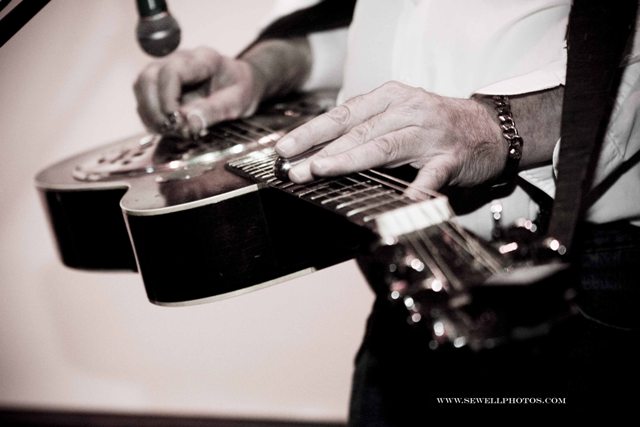
When he took his position at the mic he owned the stage. You no longer saw a short guy with an overlarge belt buckle. You saw a showman. You saw How It Was Done. He played with tremendous authority. He was able to play long passages accurately without having to watch his hands. When you consider that his left hand used a hand held steel/slide to do what a regular guitar’s frets do playing accurately without watching his left hand was quite a trick and a testament to the man’s artistry.
Josh used a “Stevens” steel. This item is made of nickel plated brass and Josh had used his for so long that much of the plating had worn off the part that contacted the strings.
His thumb pick had definite grooves in it but let me tell you, that man would take up a Dobro and just make it sing. I had a chance to play on the Dobro Josh used and wondered where the sound went because I couldn’t pull the same tone out of it that he did. That is the other mark of a true professional. The ability to get the absolute best performance from their chosen instruments. We were learning that we, as a band, did not know How It Is Done as well as we thought we did. Still, it was fun and exciting and we were on top of the world.
Uncle Josh played a mixture of blues and mountain music in his overall approach.
He clearly adapted some of Earl Scruggs’ right hand technique, but it was his fire that set him apart… And through it all he had a mischievous grin and the ability to put that grin into his style of playing that was uniquely his. Every Dobro player that came after him absorbed some of Uncle Josh because he, more than anyone else, established the instrument’s identity and raised the bar (no pun intended)
In spite of being mis-scheduled Josh went over well. Not riotously so largely due to the scheduling mix-up but he still put on two good shows that night because he did what he did so well. That was How Things Were Done.
The next morning we got another lesson when we watched him lay two tracks on a Herb Pedersen album.
That was interesting in itself. They put Josh in a booth, got a sound level check and piped in the songs in question. They only needed to play part of the main tracks on each song in turn for him once when he said “I’m ready”. The producer started to tell him what he wanted and was starting to sound like an overzealous film director.
Josh said, “Just point at me when you want me to play.”
So they turned on the red light, the producer pointed and the track was done. He bagged both of the two songs he was contracted to record on in about an hour from arrival to departure taking no more than two takes on each song. Josh even took my instrument and used it on one of the tracks which thrilled me to death
Our next gig was in three days at the now defunct Boarding House in San Francisco so we had some down time to get to know Josh and Bobby Smith.
They were both warm and congenial men each with a gentle senses of humor. Perfect southern gentlemen, very courtly and flirtatious with the women they met.
They both enjoyed a little nip now and again, preferring scotch while myself, Wayne and Tommy preferred bourbon. So, for the duration, we California guys switched to Scotch to keep things simple.
We were fooling around one night and I sang the only song I sang in those days…an old Johnny Cash song “Poppa Played The Dobro” a song about a poor man who loved playing Dobro but only had a shabbily maintained instrument. to play on.
Josh and Bobby liked my delivery on the thing and we quickly came up with an arrangement that allowed me to play Dobro on it also. This became my solo piece (with Josh playing the main of the Dobro parts of course). I got to take one break in the song so suddenly I was part of the main show. I even changed the last verse in honor of Josh but I’ll tell you about that later in this tale.
Josh told us some funny stories about his days as a “Foggy Mountain Boy” with Flatt and Scruggs. One of them was him telling how he was obliged to carry Lester Flatt’s guitar to and from the big tour bus when they were on the road. This irked him no end but he put up with it. He was, after all, only a “Foggy Mountain Boy” and not the Star. On one of their albums is a shot of all the bandsmen, including Lester, standing by the bus holding their respective instrument cases as if they were ready to board the bus. They actually were about to board but Josh said “When the photographer left, Lester put his case down and said ‘Pick it up, Josh.’
Here’s Josh’s tale of how he came by the Carlisle guitar he’d brought along as he told it to me…
Cliff Carlisle was a very well known instrumentalist in his day. He was one of the early steel guitarists (on Dobros and National’s). He played on several Jimmie Rogers recordings to give you an idea of his era. Cliff Carlisle was one of Josh’s idols.
Cliff got tired of the road and making no money so he retired from the music scene. He thought, however, that the guitar should still be played so he let it be known that it was for sale but only to a player, a musician, not a collector or speculator. Josh couldn’t afford it and it finally went to some guy who showed up with a bandaged hand. Told Cliff he could play but couldn’t demonstrate because of the ‘hurt’ hand. He paid Cliff a good price and kept the guitar for years.
Finally, for whatever reason, the guy either gave or sold the guitar at a very reasonable price to Josh. He confessed that he really couldn’t play it and thought that Josh deserved to have and use the guitar.
Later in life Josh played one of the State Of The Art ‘Signature’ Dobros made by Gibson and Cliff’s guitar was refinished and is in the Country Music Hall of Fame museum in Nashville.
Uncle Josh told me about the time right after he’d joined Flatt and Scruggs and they’d recorded “Randy Lynn Rag,” “ Shuckin’ the Corn,” etc. which had all those hot Graves Dobro solos in what was then the hottest Bluegrass group around. Apparently, according to him, Oswald Kirby offered him the opportunity to visit him so he (Oz) could give him (Buck) some tips on playing the Dobro.
Josh had a grin when he told that story.
Buck Graves told me about being on the road in the fifties with Flatt and Scruggs and being accosted in a parking lot by a rural sort who had a Dobro to sell. Buck played on it and allowed how it sounded pretty good how much did the man want?
“Two fifty.”
Well, the most Buck ever made with Earl was 250.00 a week, so he said to the man: “I can’t afford no two hundred and fifty dollars for that guitar”
“Oh no,” says the man, “I’m only askin’ two dollars fifty cents.”
I believe Buck paid him 25 or thirty dollars which was what I’d seen them going for second hand in a store back home in those days.
Another story.
When I saw him, Josh Graves traveled with his Cliff Carlisle Dobro in a case with his name painted on the side (crudely by one of his grandkids) as baggage. When I asked him about the risks involved in carrying the guitar in the luggage hold of an aircraft. He told me you couldn’t get carried away worrying about such things. “You just slack the strings and always have a couple of extra bridge saddles just in case…”
Josh told about having his 14 fret Dobro stolen. (These instruments have a brighter sound to them.) It was this instrument he recorded the “Randy Lynn Rag” etc sessions on.
Some years later a woman called him and told him to come get his guitar. Her boyfriend had stolen it and now that she was splitting up with him she thought she’d give Josh the opportunity to get his guitar back…
Now back to our story…
Early on it was apparent that Bobby’s Martin was breaking strings at the bridge. We had to talk Bobby into letting us put in a new bridge saddle on his Martin. The original bridge had chipped and kept cutting strings. Bobby’s guitar kept busting the high ‘e’ and ‘b’ string. A good friend of mine, Ron Nakamura, was part of our small entourage and he became Bobby’s string changer. When a string broke, Bobby would grab Wayne’s guitar and Ron would take Bobby’s Martin and put on whatever string broke. Well, this couldn’t go on.
Being employed in a music store (Gelb Music) at the time I determined that the bridge saddle was cutting due to bad wear that had made sharp spots. I managed to talk Bobby into letting our repairman, Doug Keith, put in a new bridge saddle on his Martin. To get him to turn loose of it we had to swear that not a drop of guitar polish was to touch the guitar.
Doug did a perfect job although he later said he was glad to get that guitar done and away because of it’s intrinsic value. The repair was made to great success and all the years of mud, blood and beer was untouched.
That Martin, by the way, needed a neck re-set as Martins sometimes do. It tilted forward some and that meant it had an extra high action. This didn’t bother Josh or Bobby because when they played it they used a capo. That was a magnificent pre-war D-28. I’ll tell you now that everything they say about those pre-war Martins is true. Hard to play past the third fret but the tone on that thing was stunning.
Josh would play “You Are My Flower” just like Earl did using that guitar. It was a wonderful sounding instrument.
I really regret not asking Josh for some pointers on technique. Having said that I learned a tremendous amount from him from just watching him but even today there are loads of questions I wish I had asked him. Still, every once in a while he would play a shot and look to see if I was paying attention.
We all had our indulgences and one night after all of us were sharing a bottle of Johnnie Walker, Josh got to talking about what a really nice guy Earl was. “If I was in trouble I could call Earl right now (2:30 in the morning in CA) and he’d do what he could to get me some help.”
The bottle made another round…
“Let’s call him!’ Josh said.
And he did. Called poor Earl at what had to be four in the morning in Tennessee or North Carolina and told Earl a tale of being in jail. Sure enough, Earl said he’d get up and send bail money…where did it have to go?”
He let Earl in on the joke (although it’s questionable whether Earl saw the humor in it.
Another interesting thing… Josh would not go into a public rest room by himself. He usually took me with him because, at 6’2”, I was the biggest guy in the band. In the early days he said he had gotten jumped by some country boys who did not like the idea of their girlfriends flirting with the musicians. “I always carried my steel in my fist to give an extra meaning to my punch but there were three or four of them that time and I just couldn’t fight ‘em all.”
Boarding House Night finally arrived.
The guys in the band were stoked. We were going to be backing up Josh Graves and Bobby Smith. And we also got to open the show! On our home turf!!!
Surely our fans were legion and the place would be packed to the rafters!
Well, we only got half a house.
But still, those were our people.
We would conquer, like the Beatles, it would be the show everyone wished they had been to.
I was a bit apprehensive. As we lined up to do our opening routines I asked myself why in the world I thought I should be opening for Josh Graves. What possessed me to do such a foolish thing? And a thought occurred to me… “I play too”… And I instantly relaxed, ready to play…
The announcer intoned his intro and the curtains opened… we were ON!
We were to open with a Louvin Bros song that moved right along…”I Wish You Knew.”
For some unknown reason they opened it in a key that was a tone, tone and a half sharp from it’s rehearsed pitch. Probably a little keyed up and overexcited.
…and played way too fast.
It is the suspected that the ingestion of certain stimulants were possibly the culprit but inn any case, there we were, five guys all playing the same song, in different keys, all at once.
That little surprise took a bit of live, quick thinking recovery but it threw us off our stride. We held it together long enough to bring out Josh. He and I got through ‘Poppa Played The Dobro’ without incident and I was allowed to escape to the wings and watch the rest of the show from backstage.
We got through it but I began to see that we weren’t anywhere near in the class of Josh and Bobby musically and here’s why.
There are always exceptions but the idea of the professional musician is to Make No Mistakes and Make It Look Spontaneous. Band mistakes mar the show and If you were just a sideman, in the real musical world you could get fired and replaced rather quickly,
Not looking spontaneous makes you look bored and condescending…things the patrons do not want to see. Having said that, most bands you see in concert have had hours of hard rehearsal, a luxury we did not have so some errors were unfortunately made and our polish was not always up to snuff.
That is part of How Things Are Done.
It is one thing to have a temperamental star. We were fortunate that Josh and Bobby were definitely not temperamental. But the star’s name is on the bill and you pretty much have to take what you’re given in that respect. Some (but not all) stars in all the musical fields were prima donnas and not all of them were musical savants.
But as I said, it is the star’s name on the bill and the band, to be considered professional, needs to perform flawlessly. To do less is to affect the star’s turn negatively. This is a risk artists like Josh take when they use local pickup bands. It will save the expense of hiring Nashville hired guns but you risk not having the stable base that a truly professional level band provides.
Both of these men had a warm, gentle sense of humor and were very careful not to say anything bad or negative about our musicianship. They were very supportive to work with but, looking back on it, it’s a wonder they were able to stand it. I often wondered if we cured them from ever using pickup bands again. Maybe it is just me wishing myself and the other guys would have been more solid sounding with fewer clams. At the time, though, we were the most fun having bunch you ever saw.
I may seem overly harsh on our little group in hindsight here because we did enjoy playing with those two men in spite of our occasional embarrassing spots. The audience, after all, just wants to hear music and are generally more forgiving than a music critic or other musicians (like myself) might be. A large part of my negativity is knowing we boys (myself definitely and absolutely included) could have and should have done better musically. Particularly on Boarding House night.
Everybody was glad when the Boarding House gig was over except for Wayne because the gate wasn’t near what he had hoped. Wayne was starting to worry about money. We had two more gigs to do featuring Josh and Bobby. One, a gig the next night at a joint in Berkeley who’s name escapes me now. Following that was the first annual Grass Valley Bluegrass Festival. Josh Graves and Bobby Smith were the headliners.
After seeing the light house receipts at The Boarding House, Wayne began to see that perhaps he overbooked since Berkeley was very close to San Francisco. Why would someone pay to see an act in San Francisco and also pay to see the same act in Berkeley the very next night? Particularly since the headliner is playing an instrument unknown to most people. To make matters worse, ticket sales for the Berkeley gig were flat. We showed up at the venue but no one else did so we never even played the room.
Wayne still had to pay Josh and Bobby plus pay their air fare back to Tennessee. He didn’t have the money and it looked like he wasn’t going to get the money…
Wayne was in trouble…
Grass Valley, our final gig, was a one day affair. It had a light turnout mainly because it was a new event and possibly also because while everyone attending knew who Uncle Josh was Josh just did not have the draw of someone like Emmy Lou Harris and others who would headline the event in years to come. The annual Grass Valley show eventually became one of the Must Sees to bluegrass aficionados.
Still and all, it was a beautiful setting at the fairgrounds in Grass Valley. A lot of redwoods and the people who did come were in good humor and were True Believers.
Several well established local groups played on the stage through the day and I was impressed with the sound setup on the stage. The sound tech had a line made on the stage. The microphones were on one side of the line, the performers on the other. If you were a singer or soloist you stepped up to but not past that line. If you were the supporting players you were to be exactly two paces behind the solo line.
And it worked flawlessly. The musician could hear themselves perfectly as could the audience. It was our finest hour as a group. Everything meshed, no one made mistakes.
I did my last “Poppa Played The Dobro” with Josh. Everybody else played well and the event faded into history… one of my fondest memories of it is seeing Josh and a young Sally Van Meter sitting cross-legged on the grass across one another as they worked out some chops. It just epitomized the feel of the day…
Grass Valley was a small success in a beautiful arboreal setting…
The Palomino club and the Boarding House gigs were not what they should have been and Berkeley was stillborn. Having said that, all of them had their high spots and as I said, the audience came to hear music and they got it. We, as a small, loose-knit pickup band got to play with one of Bluegrass music’s most iconic musicians and we gave it our all. Like the song goes, “You Can’t Take That Away From Me.”
To their everlasting credit, Josh and Bobby agreed to forego the Berkeley gig and did not demand payment. Wayne had to borrow money from Bonnie, our “girl singer” to cover the expenses of getting the two men back to Tennessee…
After Josh and Bobby left, the band itself had one more local gig that was pretty anticlimactic. By then some of the members were barely on speaking terms. . It just collapsed on itself and looking back on it I don’t think I ever saw any of the participants again since. Certainly not in a stage setting.
Josh and Bobby showed us a side of musical life we weren’t aware of. People like to think “Being Famous” is all you need to make big bucks in The Business.
But Being Famous in your field does not necessarily equate with being wealthy.
Among Dobro players there is only one Josh Graves. All of the greats, Jerry Douglas, Mike Aldridge, all of them cheerfully admit being inspired and mentored by Uncle Josh. But he was far from being wealthy.
Josh made as good a living as he could but as time went on he had some devastating medical catastrophes happen. The first event was bypass surgery on his heart. This is difficult to manage when you have insurance but Josh did not have any such thing. He had no choice but to keep working.
As you get older in the business, your bookings start to drop off. The phone doesn’t ring as much as it did just a few years ago…
Then he got diabetes. Between the diabetes and a surgical procedure involving trying to transplant blood vessels in his legs something went terribly wrong and he eventually lost both of his legs. He took as many gigs as he could, playing in a wheelchair and laying his Dobro on a table built to order by friends but it all took its toll and he eventually died “from complications” in what was left of his legs in September of 2006 very near his birthday.
He was around eighty years old…
I haven’t sung Poppa Played the Dobro in years.
When Josh and Bobby were here and Josh was playing for and with me on that song I changed the last lyric.
The original goes like this…
Now that Poppa’s gone away
It’s hanging by the Flue
The strings are all rusty
The resonator’s rusty too
I just know it’s never gonna sound
The way it used to do
When Poppa Played The Dobro This a way…
I changed that part and Josh and I did it this way:
Now that Poppa’s gone away
I’ll tell you what I’ll do.
I’ll sit here and I’ll play it.
And I’ll play it just for you.
But I just know it’s never gonna sound
The way it used to do
When Poppa Played The Dobro This a way…
A footnote:
I got to work with Wayne and Bobby Smith on one more occasion.
Wayne booked Bobby to play a ‘Day on the Green’ at Bay Meadows racetrack. Bobby very kindly requested that I play Dobro for him.
He taught me a couple of valuable lessons.
First, he told me: “I play rhythm. If we don’t mesh and play together in time you best believe it ain’t because of me!”
Next, he took me through “Little Rosewood Casket.” Sang it through for a verse then asked me to play it.
“Nope, No, No, yer playin’ it wrong.”
“How so?” I asked.
So he showed me. He made me play the melody as he sang it. He would pause until I got it right, and then go on. Only when I was able to actually play the melody line perfectly all the way through would he allow me to back him up on the song.
“You were playin’ at the song …now you kin actually play the song. Without being able to play the song proper you just can’t do it justice in a band situation.”
Bobby’s dead now. Too bad. He was a warm, but firm musician and a gentleman. I can still hear him walking me through that song…
“Thar’s a leetle Rose-wood Caskit…Settin’ on a mar-ble stand…”