From The Bar ~ Make ‘Em Dance!

Another segment of a project The Rise and Fall of a Saloon In The Latter Part off The Twentieth Century. These excerpts are not chronological. In fact very little logic prevails…


websize
A saloon is a man’s domain by virtue of attendance.  Men go to a saloon for the ‘good ol’ boy’ camaraderie…the sport talk… the loud dice play
There are always more men than women in a saloon but the men that are there keep hoping it will change.   Although they seldom admit it, the men like the idea of having women around.

If you cannot find a way to attract women, a lot of women, to your saloon what you end up with is a neighborhood bar.  Neighborhood bars are fine, don’t get me wrong but the difference between a neighborhood bar and a saloon that is a nightclub is the difference between a mom and pop grocery and a Supermarket.

Most women who go to saloons go there because they want to be entertained.  They want to go out with their friends, male or female to see and be seen, to laugh and have a good time.  Maybe even go home with someone for some joyful carnality.  But, first and foremost, women go to a saloon for one thing…
Most go because they want to dance!

_________________________
Yonder comes the invading hordes…
        ‘Dim Lights, Thick Smoke, and Loud, Loud Music…’___ old country song


The customer comes into the parking lot, parks the car, gets out and goes to the line that has already formed.  Inside the foyer they see a picture on the wall near the doorman.  It is James Butler Hickok, “Wild Bill” himself, in a small 4X8 frame in the famous photo posed in his buckskins.  Ivory handled Colt pistols thrust, butts forward, one on each side as was his habit and a long, unsheathed, butcher knife carelessly stuck under his belt.
His hair had been oiled and hung in ringlets his mustache trimmed… he looked Elegant.


“No Sidearms Permitted Within”


 …was the admonition scripted beneath the picture…
Wild Bill in his finest hour reduced to a Xeroxed clipping in a dime store frame…posted at the front door of the kind of business he knew and loved…

The doorman is collecting a cover charge tonight and some patrons groan and challenge the need for this.  They claim they feel insulted that they should have to pay.  They have no real reason to put forth why they should be exempted.

There is not a mortal living who does not think they deserve special treatment, particularly in places like this.  Special treatment is, after all, status!  Getting special treatment, like getting past the doorman without paying cover or having the bartenders call  you by name, gave some people a sense of importance.

The truth is “They learn you by what you drink before they learn you by your name.”

There are some very creative lines used to try to get past the doorman without paying but none of them work because he’s heard them all.  Besides, it’s a good band tonight.  If they’re not on the Guest List they’re out of luck.
They pay their money and go in.  By eight o’clock the band has started and if  the patron is lucky they get a seat.

The waitresses are busy tonight so it might take a while for the drink to arrive at the table but they know it will eventually get served up.
Or the customer might try their luck at the bar.  One way or another they find their spot and take it all in…

Much as the men may like music that’s really not why they’re there.  They’re either on a date or they’re looking to meet someone.
Oh, some may say they are there ‘just to have fun’ but it is largely to see and be seen.

But deep down we all know why they’re there… they wanna get laid!
____________

Entering a saloon is almost like being thrust back into your high school years in that you want to be accepted and be deemed popular by joining a group of insecure, self centered creatures that are largely strangers.


It’s worse, actually.  

    In a Saloon the insecure, self centered creatures that are largely strangers have  been Drinking…
                                                                                            ____The Write Down Book

_____________

It is always interesting to see how individuals scan a room.

 Guys look around to see if they’re noticed.  They ‘check out the stock’ as one guy put it.  ‘Check out the babes.’

The boys do the Turkey Strut and try to catch a Hen…
Bird Dogging is rampant…
It is The Mating Dance in full force.

 Women check out the competition.  Then, if they’re On The Hunt, they will do their own version of ‘checking out the stock.’
Girls don’t worry about being noticed.
They are women.
Everyone notices them.

      They watch the men doing the Turkey Strut with some amusement because the women know that no matter what a guy does or says it is ultimately a ladies choice.  (Please refer to the Mighty Hunter Speech elsewhere in this series).

________________

The difference between a neighborhood bar and a night club is that at a live music Saloon will be having said live music.
Bands, if they’re hot, a DeeJay if they cannot afford bands or Karaoke if there are severe space limitations.
And if you do it right, women will flock to your saloon, all pretty and bright eyed and the men will follow in at LEAST a three to one ratio if not more.
Get that right and your saloon will make money!
Get it wrong and you just have a neighborhood bar.

The best band years for The Bar were when it first opened up.  One of the bartenders, a lovely lass, tall, with waist length hair, was the Music Director and she did the whole thing, audition the bands live, book them, handle the publicity including print media.
She even ran the sound board but most of all, she would drive to the different clubs in the area and see who was playing where and what kind of draw they pulled in.  Her “era”, if it could be called that was roughly two and a half to three years.

The Bar was brand new then, lean and sassy and, outside of a few bars that featured hardcore country, they were the only club for a twenty mile radius.

Those days had some really great bands.  Most are gone now.  Some are considered absolute legends.  The musical lineup in the first days, actually the first couple of years,  was varied indeed…

There were excellent rock and roll groups… Uncle Rainbow…Stu Blank and his Nasty Habits…50’s retro groups like Daddy-O… marvelous country western flavors like Back In The Saddle…Chuck Wagon and The Wheels…  There was Flip Nunez, among others, for Jazz  which was on Tuesdays…Country flavors on Wednesday, new bands on Thursday and full on rock and roll on Friday and Saturday featuring variations of covers of the music of the day…

All of those bands made people get out on the dance floor.  Made ’em Dance!

  Those bands are, for the most part,  gone, now, of course.  Saloon bands seldom got out of the ‘club circuit’ in those days and either burned out or graduated to a better paying circiut in their never ending quest for “The Big Time” of Fabulous Fame and Fortune.
Consequently, most of those bands are just names written in the dust.   If you had never seen and heard them (and most of you have not) they are just that…names.

Over time The Bar had to cut Wednesday and Thursday night music.  There was no money in it after you staffed the crew, waitresses, bartenders and doorman.  There was also the problem of attendance.  The Bar was, after all, located in a small town.  Not many local folks were in a position to ‘party hearty’ and go to work the next day and there was no reason for tourists to look The Bar up.  The local people preferred to let it all out on the weekends.  So the live music eventually got reduced to Friday and Saturday nights plus Jazz on Tuesday night.

The lovely who did the booking during those heady days eventually left (some say ‘escaped’) the bar business and went on to other things.  Her position was taken by yet another young woman.   It became clear that an era of sorts had passed.  The new bartender/booker was not as successful in her bookings so she too packed up her tent and left.

Was her lack of success simply bad taste in music?  Probably not.

The Bar had one built in flaw.  It had a posted capacity of 180 people.  Of course, on a good night this  might get exceeded but not by a whole lot.  Some people love crowds, some do not.  It is hard to enjoy yourself in a saloon if you cannot sit and be comfortable at least part of the time.   When you limit how many people can get into your place of business you limit your potential income.  But still, it could be a struggle to keep your 180 patrons coming in steadily.

  Some of the better bands knew they could get more money if they played a larger venue for obvious reasons.  A larger venue meant more money at the door and in most places this money had a direct effect on what the band got paid.  Some bands that played The Bar demanded and got a higher cover charge and just worked for the gate and did very well indeed but these bands were rare and you could count them on one hand.

In any case, T.O. had a budget, a limit to what he would pay bands and that often hinged on a cash plus part of the gate.  Or nothing from the bar and the band takes the gate.
Some bands…and it eventually became most of the really heavy drawing bands…would no longer play there.  It just didn’t pay them what they thought they were worth.

The bands The Bar could get still had some good music and excellent musicians but between the expense of the bands and especially the increasing local competition, the crowds could no longer be taken for granted.
Eventually the band booking duty fell to me.
I’ll start right off and admit to a weak spot when it came to booking bands.  Looking back on it all it may have been something of a liability.
Or maybe it wouldn’t have mattered anyway.
I did not drive at the time.   The problem this caused was that I could not go to other clubs and see bands in action.  Audition them live. And more importantly, check out the crowd draw.  See what they brought in.
I’m a musician.  For a few years I played with the great and the near great as they say, along with a goodly portion of talented amateurs and local saloon bands.  A few years of working in a music store gave me some diversity of exposure and I knew hundreds of musicians on a first name basis but that’s not good enough.

We will come back to my band booking chores in another chapter…

In the meantime, rememeber this…
The paying public wants one of three things from any live music they’re faced with.
They want it unobtrusive if it’s background music.  Maybe that’s’ why they call it background music.
They want it perfectly played if in symphony.

In a live concert it must be spontaneous and exciting.

But in a saloon…
It must be entertaining at all times.
….but more importantly… if you want ladies in your saloon…
You must make ‘em DANCE.
From The Bar ~ Saloon Economics ~ Pricing

Another segment of a project The Rise and Fall of a Saloon In The Latter Part off The Twentieth Century. These excerpts are not chronological. In fact very little logic prevails…

There are four pricings on liquor in most full service bars depending on the cost of the product used.  “Well” is the lowest price. These liquors are usually found in the “speed rack”, the array of bottles kept in wire racks at bartender thigh level for easy access.
After that come your “Call” which may or may not be included in the speed rack depending on the saloon.  Usually, though, “Call” brands were displayed so the customer could see and recognize the brand.  “Call” is followed by “Premium” in pricing and sometimes “Super Premium.” which are progressively more expensive.    These last two categories are sometimes kept in a visually exclusive area so the customer can feel his order has Extra Special Status.

                                                                Pour Cost

There is a thing called “Pour Cost” that is critically important to a saloon’s fiscal health.  This is the calculative guide saloonkeepers use to figure out approximately how much it costs to pour each drink. 

From the web we have this definition:

_______________

“…Pour Cost – jargon for cost percentage – is a reliable indicator of profit/loss performance.
Pour cost is obtained by dividing the cost of depleted inventory by the gross sales generated over a given period of time. Because liquor, beer and wine sell at radically different cost percentages, each must be calculated separately for the process to have true significance…”

__________________

To allow The Bar to apply this formula part of the closing bartender’s duty was to line up every bottle of alcohol emptied that day on the end of the bar.  This is called the “Breakage.” 

       Here we have a little historical interlude…


The history of the word ‘breakage’ allegedly came about after Prohibition.  It was a common practice in the early alcohol industry to re-use bottles or worse, refill an empty bottle having an expensive brand’s label with an inferior product.  Laws were passed that required saloons to at least break the necks or shatter the empties at end of their service to make them unusable.  Hence the term “Breakage.”


The empties are itemized on a clipboarded chart, brand by brand according to its rank in the call order.  Beer tallies are by cases sold or kegs emptied as are the mixing liquids such as Coke and Tonic etc.  These numbers are totaled up by the resident number cruncher, The Formula is applied and the end result is the Pour Cost.
 Ideally, in an efficiently run saloon the pour cost would be  around .22 or less meaning out of every dollar taken in, twenty two cents is spent on the actual amount of liquor used in pouring a drink. 
Some saloons, like The Other Place opted for dispensing guns, a buttoned control that precisely measures the alcohol dispensed. 
T.O. did not like dispensing guns.  He liked the idea of  his customers actually seeing the label on the bottle as the drink is poured.

                                             T.O.’s pour cost was never anywhere near the ideal. 

Pay attention, kiddies… Pour Cost and Profit… is the true Bottom Line.  That which actually determines the Rise and Fall of a Saloon.                     

 There are three ways to dispense liquor using a Bartender.
      You have your metered guns.  The most precise and controllable.  Also the most impersonal.
      You can have a bartender use a measuring cup called a “jigger”.  The ‘jigger’ is a double sided metal measure.  One cuplet measures one ounce and the other side measures and ounce and a half.  A shot glass is a more attractive way of measuring the amount poured.  Some shot glasses used for this had a white line that the bartender would of course pour past that line for effect.
      Or you could have your bartender pour the drink without any measuring devices at all.
    This is called “Free Pour”.

All pouring was assisted using special spouts “pour spouts”,  inserted into the neck of the bottles that are designed to keep the flow of liquid steady and controlled no matter at what angle the bottle is held.  It uses the simple physics of routing the liquid through a tube narrower than the open neck of the bottle.  This allowed a truly skilled bartender to vertically up-end the bottle and vary the distance the liquid actually flowed in impressive flourishes to delight the eye.  The spouts were designed to make a little cheerful sounding, bubbly noise, as they dispensed liquor.  In reality they were still dispensing the same amount of liquid that would be dispensed if poured in a more staid, measured, method. 

Free Pour, to the viewer’s eye, looks to be more generous than a measured amount, carefully poured, using the jigger/shotglass method and certainly more interesting than that generated by a dispensing gun. 

Even so, a skilled Free Pour actually dispenses the same amount if the gun is calibrated to the industry standard..  Notice the word “skilled”.  I’ve used the word ‘skill’ a few times already because skill and being skilled is extremely important.  People tend to ignore that word but in this case, skill affects the money line.

The Bar and The Other Place and most of the local saloons were expected to pour an ounce and a half of liquor when a drink recipe called for a “jigger” or “a shot” of alcohol.  Free Pour was the ability, nay, the skill,  to pour that ounce and a half without using a ‘jigger’, shot glass  or other measuring device and come up with exactly an ounce and a half of booze in the drink.

At The Bar Free Pour amount was measured by cadence, usually by counting to four in one second increments. 
Bartenders in training were given an empty liquor bottle and a pour spout and sent home to practice until they got Free Pour down correctly. 

A visually clever way to test this was to pour into a brandy balloon glass and, having done so, tip the glass gently so it lies on its side. 
A perfect ounce and a half Free Pour will go to, but not run over, the edge of the glass.   This is a clever technique visually but a better test is more realistic.  That is to Free Pour into different sized containers, with and without ice, then measuring the results in a measuring device of known value… a shot glass or jigger… to see just how accurate the bartender’s pouring wrist is.
 

 There were problems with a Free Pour.  Some people never got the hang of it and either wasted booze or shorted the customer.  Neither was good for business and it didn’t help the bottom line.
 It’s amazing how complicated some people can make counting to four.  Equally amazing how some cannot achieve this simple act at all.  If a bartender didn’t work well under pressure of a crowded, loud, night the Free Pour (and the Pour Cost) could be affected adversely.

 The bartenders hated to be denied, however, and regarded having to use a shot glass to pour a drink to be like using training wheels on a bike.  They also felt they could do better with tips using Free Pour because it looked more generous than scrupulously measuring using a gadget.  This is particularly true if the bartender has sparkle and knows how to flourish and exploit the time it takes the pour to finish.

A well executed Free Pour was an asset but a bad one was its own trap because seasoned observers knew how to count to four too and no one likes to be short poured…

If your bar indulged in Free Pour you had a very real danger of over-pouring by a bartender looking to increase the tip factor by appearing to favor a customer. 

                                                       “Have a Drink On The House!”

Pour Cost is affected by pouring ‘free’ drinks because, of course the product is not free. 

                                             It is paid for by the owner. 

Some comping is necessary for good public relations.  In fact T.O. had a “P/R key” (for ‘Public Relations’) on his register to try to keep track of the “on the house” drinks.  Most bars make a provision for this.  This could be abused by a less scrupled bartender looking to increase their tips by pouring a drink “on the house” for a customer who tips well.  Some would do this without even bothering to ring it on the P/R key.

Then there are your surveys:

“…according to a survey done by the California Restaurant Association, the average bar or restaurant loses–simply loses–25 percent of its beverage alcohol. One-quarter of the wine, beer and spirits in the average restaurant or bar simply disappears, due to spillage, over pouring, mistakes and outright theft…”
Ah, yes…theft!  Sometimes…sometimes a bartender at The Bar goes a little farther to have more than a small effect on Pour Cost.  And that was due to the fact that the bartenders had their hands on company cash.  They handled T.O.’s actual money.  Money is always a temptive thing…

   Bartenders, being as they are, in a trade that is somewhat nomadic at times, occasionally produced someone who “skimmed a little,” using whatever rationale they conjured up to ease it in their mind. 

And there were those who flat out stole from The House.   If the pour cost was calculated weekly, thievery would eventually be spotted because it caused strange fluxuations in the Pour Cost.  Even so, a skilled thief could cause a lot of damage in the long run before they were found out and terminated. 

                            The losses incurred came, of course, out of the owner’s pocket.

                 After your Pour Cost is determined then comes The Open Palms.

Your city license, your state liquor license, cabaret license, BMI/ASCAP licensing, state and local taxes, ‘contributions’ to Social Security and Workman’s Comp, liability insurance, lease/rental of the actual premises, such money spent on necessities as utilities,  gas, garbage disposal, ice machine servicing, refrigeration costs.  Quite a list of hands wanting to get paid First. 

Then comes your inventory.  In California, if you ran out of a certain brand of booze you couldn’t shop the local stores for the best price.  No.  You had to buy from a state licensed supplier.  

Inventory could be even more costly if your saloon, like The Bar, included food service.

You must also add extraneous repairs as might be needed which include the obligatory visit from your local Roto-Rooter four times a year to snake out the toilets. 

Lest we forget there must be salaries paid to the crew.  And with that comes all the fun and taxes that come with payroll.

             After all that is paid and/or accounted for the amount left over, if any, is profit.

From The Bar ~ What Kinda Beer Ya Got?

Another segment of a project The Rise and Fall of a Saloon In The Latter Part off The Twentieth Century. These excerpts are not chronological. In fact very little logic prevails…

                                                                  websize

Beer is a very popular beverage.  Sometimes, particularly during the football season, one would think from looking at television that beer is a major part of the national GNP.
There are all kinds of beer.  “Boutique” beers made in mini-breweries, imported beer, domestic beer.  There are light beers, dark beers, stouts, ales and pilsners.  There is canned beer, bottled beer and beer on tap.  Some of the brands have “Lite” versions.  The list can be endless.
There are some saloons that specialize in beer.  They can have beer menus that look like small novels and an array of tap handles that look like a mini forest of ceramic and tin.
The Bar had a smaller roster of beer.  After all, they were a “full bar” dispensing a variety of alcoholic choices and could not dedicate themselves exclusively to those who think fun starts and ends with beer.
Still, they had a respectable list of choices that changed from time to time as T.O. (who was one of those who really Did believe fun started and ended with beer) liked to keep things interesting.

I wasn’t a beer drinker.  I favored bourbon, particularly Jim Beam or, for variety, brandy.  I wasn’t one to experiment with brands because I was one of those who tended to be brand loyal.  Being of this persuasion I was endlessly amused to see an oft repeated movie we call…

What Kinda Beer Ya Got?
      It goes like this:

The customer comes in, full of good humor, pulling out his wallet and approaches the bar.

The bartender opens with…
“What can I getcha?”
“What kinda beer ya got?”
“What kind do you want?”
“What kind ya got?”
So the bartender recites the litany of beers in stock, sometimes twice, since the list entailed almost twenty brands.
The customer thinks for a minute, and asks for a brand not on the list.
“You got ______?”
“No, we don’t have ______ “and runs through the list again.
“You don’t have _______?”
“No.”
“Gimmie a Bud.” (pronounced: “Buuudd..”)
Now, of course, instead of ‘Bud’ it may have been Coors or some such but it was almost always something very common, a brand usually one seen on TV and seldom was one of the more discerning of the listed beers.
I watched this and saw how an indecisive seeker of suds could hold up production on a busy day or night so I had a brainstorm.

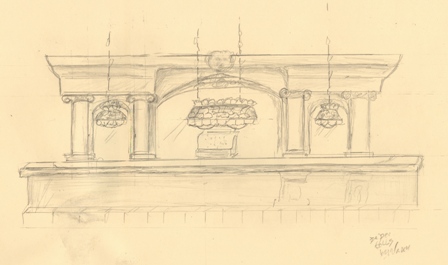
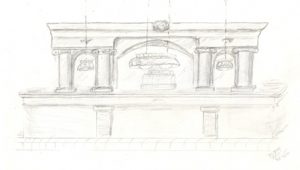
I had a local carpenter cut some slats of thin plywood about two inches wide and a foot long.  I painted these black and using white stick-on letters I could put the names of the different beer brands on them.  I rigged a way to hang these slats ladder-like from the center archway, clearly visible from anywhere in the room.
This made things ever so much easier for the busy bartender or waitress but it wasn’t a total cure.

There was always the customer…

“What kinda beer ya got?”
The bartender points at the list.  “Everything on that list.”
The customer squints at the list.
“You don’t got ___?”
“No.”
“Gimmie a Bud!”

T.O. eventually put in keg beer.  He had a cooler built outside of the building that held six kegs and fed the beer in through lines.  He did not sell beer by the pitcher because that kind of sale could attract a certain crowd he wanted to avoid.  Rowdy biker types seemed to prefer pitchers and he thought pitchers encouraged excessive drinking. Finally, the pitchers took up far too much room in storage.

With kegs the question got modified:

“What kinda beer ya got?”
The bartender points at the list.  “Everything on that list.”
The customer squints at the list.
“You don’t got ___?”
“No.”
“Whatcha got on tap?”
Same response, shorter list.
“You don’t got ___?”
“No.”
“Gimmie a Bud!”

Some customers, manly men they, preferred to drink their beer straight out of the bottle.  With keg beer this was impossible of course.  Some  preferred drinking their beer out of a glass, pouring the bottled goods into said glass.

Now there is a bit of an art to pouring beer….

Drawing a “perfect” beer from a tap, while not requiring genius, does take a little bit of skill or at least some attention must be paid, to do it right..

Broadly, the regimen is:

You must first start with a glass clean of any residue, including soap film.
Place the glass at a 45 degree angle, one inch below the faucet. Do not let the glass touch the faucet. Open the tap spigot all the way in one swift motion.
After the glass has reached ½ full, gradually bring the glass to an upright position.
Let the remaining beer fill straight down the middle of the glass. This insures proper release of CO2 by producing a ¾” to 1″ foam head.
Close the spigot completely in one quick motion.  A clever bartender will work on their finesse at the tap to give a bit of a show for the customer.

Being a good bartender is a bit of Show Biz, after all….

Sometimes a beer will come out of the tap foamy, particularly if the keg has recently been wheeled into position and hooked up.  Some beers start out of the tap foamy even after the kegs have settled which requires the technique to be modified to some degree.  In those cases, the tap had to be opened and run until the beer cleared then the glass put under the column of beer at a 45 degree angle as explained above.  This wasted product but couldn’t be helped.  This was costly.  Expensive.

If the glass was not clean, particularly if it was not rinsed of soap residue the head would not stay on the beer but this was seldom a problem at The Bar.  After they had been open for eight years or so T.O. put in a back bar dishwasher which helped move things along swimmingly but in the interim both stations had three sinks, one for soapy water, one for first rinse and one for second rinse, that  sink having a tablet of bleach added as a disinfectant.

Bottled beer has it’s own technique to be poured ‘perfectly”.  It’s not too different from the method of drawing beer in some ways.  Basically it goes like this…
You still need to start with a clean glass.  Some say the glass should be moistened.  The Bar chilled their glasses as a rule and when the glasses hit the open air moisture would condense and apparently fulfilled that requirement.   Pour the beer slowly down the side of a tilted glass, resulting in a smaller head which allows more carbon dioxide to remain in the beer. If you hold the glass upright and pour straight into the glass, more gas is released, and a larger head will form.

Some people never ‘got it’ and the novice bartenders of course were the worse and if they wannabe’s didn’t get the hang of it quickly they were discouraged from a career in “mixology”.  Most soon got the hang of it and even I, not being a beer drinker, could draw a perfect beer every time in the rare times I was called upon to do so.

But even with the finessed technique and the care and attention paid to making the proper pour the original conundrum still applied…

“What kinda beer ya got…?”

Paper Doll’s by Vann ~ The Titanic

Every painting has a story but some have more story than others…

James Cameron’s TheTitanic came out in 1997 and was, as we all know, a huge hit.
I saw it and I thought the visuals were pretty impressive.  The epic special effects chronicled the historical disaster as best it could, being wrapped as it was, around  a fairly standard Hollywood rich girl/poor boy romantic potboiler.

Others, I found, did not share my cavalier impression of the film.  Some got quite wrapped up in it.  ‘Immersed’ might be a better word.  Some people got so enthralled with the movie one would think they had gone down with the doomed ship.

One of these people happened to be a young woman I’ve known for a good part of my life.  She was one of the Titanic survivors in a manner of speaking.   For some, surviving the movie itself and not becoming a sobbing basket case afterward was it’s own form of surviving the sinking .

There were a lot of things you could buy centered around that movie and she had more than a few of these…  She was definitely into it.

I was painting quite a bit around that time so it was only natural that I would try to paint her.  She was a pretty lady but she was very hard for me to capture with my brush and paint.  I work from photographs rather than sittings and portraiture is hard for me.  It is doubly hard to do if I know the person being painted well.

I had a certain photograph of her she’d let me copy.  It was of her, taken in one of those touristy photography setup shops where they shoot you wearing costumes, cowboys, turn of the century stuff… you’ve seen them.

She had donned a Scarlett O’Hara/Southern Belle outfit…. hoop skirt, parasol, hat and gloves…  Her face in the shot fascinated me.   It was almost angelic, a sweet serene expression with a vixenish hint of a smile…  But I just couldn’t catch what I saw using watercolor.  I tried using that face as a model several times with no success.  I had turned out enough failures trying to paint her that she may well have thought I’d never succeed making a painting of her.  I was beginning to think the same thing.

…meanwhile, back on The Titanic

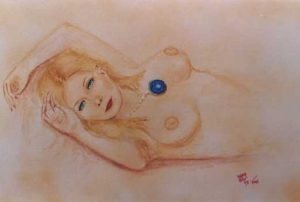
There is a scene in the movie where Kate Winslet’s character is laying pleasantly naked on a couch and De Caprio’s character is doing a charcoal sketch of her.   This scene and the resulting sketch got a lot of attention in the movie.  It also gave me an idea.

I didn’t have Photoshop but using my scanner and some voodoo, I got that photo of her face maneuvered onto the movie sketch.  I then ‘cheated’ and used an opaque projector so I could trace the result  to help me block it out on a piece of 20 x 30 illustration board.

I worked on that for about a week but I bobbled the “blue jewel”, a central thread of the picture and the movie both…  I had no idea how to make blue jewels.  I’d never tried to make any color jewel, let alone a blue one.   I reluctantly set the work aside.  I even thought of throwing it away but the face was intriguing even unfinished.  All  I’d had done on it were the eyes and the lips and a vague outline.    You can ruin a watercolor by overworking it so I stopped work on it but kept it around.  I figured I might at least save the face as a painting on its own merit.

On a whim I used a Polaroid camera and snapped a shot of the unfinished painting.  I scanned that and e.mailed it to my friend  to show her what I had done.

Well, that got her attention and she begged me to try to finish it.

Watercolor is touchy folks, particularly if you’re trying to do repair work on it.  You can’t just daub over it like you can with acrylics and oils.  You run a very real risk of losing your paper to agressive wetting as you try to draw off some colors and otherwise try to fix things.  I started with the Blue Jewel because if I couldn’t get a sense of that then the rest would not work.  Some fixes work.  Some do not.

How did it come out?

Honestly, it has problems because of my lack of training, but my friend was thrilled.
She was pleased so if she was pleased I was pleased…

I somehow had managed to rescue the blue jewel and in so doing salvaged the painting.    I don’t think I could do that photo of her face any better justice than what I have here.  My friend has a bit more endowment going for her than Kate Winslet had but that just requires extra attention.  One does what one must do…

I’ve known her a long time, now that I think of it…

which has nothing to do with the painting.

Or the story…

the painting is signed, as they all are…

Paper Dolls by Vann

liarose

A musical interlude~ ‘Last Thing On My Mind’

I hate recording because it is never what I want it to be.  So damn many clams!  It’s because I don’t practice enough.

Having said that, I have friends that want to hear what I do with my spare time besides have demented fantasies filled with beautiful women and Ben and Jerry’s ice cream…

This is an old song from the sixties by Tom Paxton, I think, called “Last Thing On My Mind“.  

First time I ever heard it was by way of Doc Watson.  I looked up the lyrics about a year ago…I don’t always hear lyrics perfectly when sung, you know… and was struck by the poignancy of the refrain…

I should have loved you better

Didn’t mean to be unkind

You know that was the last thing on my mind…”

It puts me in mind of a certain lovely girl I knew, all too briefly, a long time ago.  I certainly didn’t mistreat her but I should have treated her better…

                        didn’t mean to be unkind…

                                                          that was the last thing on my mind…

I think we all have past loves that fit that train of thought…

So here’s the song, warts and all…

All mistakes are intentional….

No real musicians were harmed in the creation of this noisemaker.  Band In a Box was used with the exception of the soloist. 

We try to keep him chained up in the yard but he keeps gnawing his leg off and escaping…

last-thing

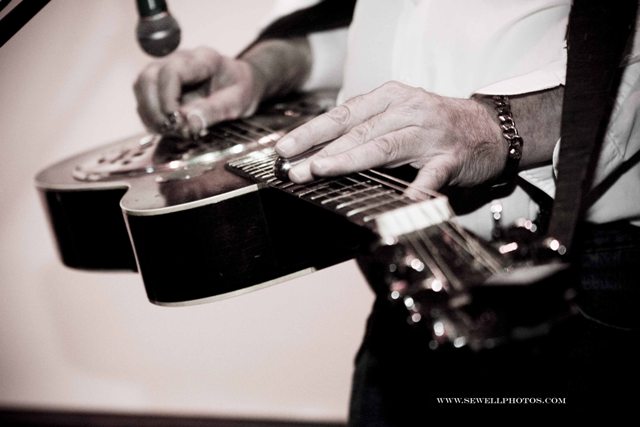
photo by http://www.sewellphotos.com/